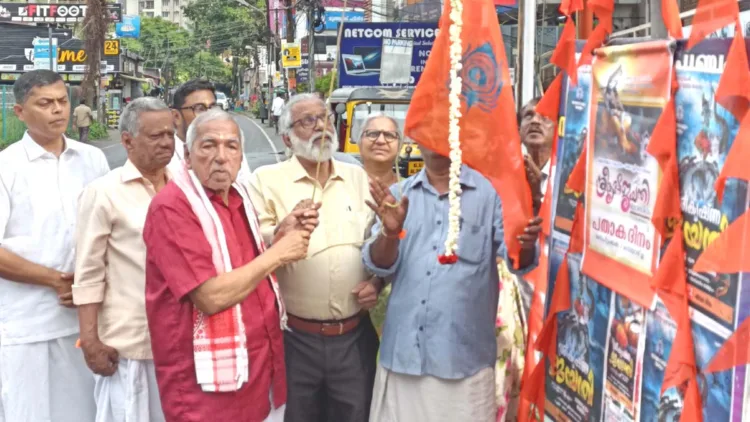
M. A. Sir, who enshrined Kannan in the tender hearts of Kerala
Introductory Memo: A. Krishnan, popularly known as M. A. Sir, was a prominent RSS pracharak and cultural organiser who played a significant role in Kerala’s social, literary, and cultural life. Born in 1929 in Kollam district, he became an RSS pracharak in 1954 and later served as editor of Kesari weekly, where he helped establish Balagokulam as a major children’s cultural movement promoting Indian traditions, values, and devotion to Lord Krishna. He also founded and strengthened Tapasya, bringing together prominent Malayalam writers and cultural figures and encouraging dialogue around Indian cultural traditions. The article credits him with contributing to cultural and social initiatives, environmental and temple-related causes, and opposition to certain harmful traditional practices. During the Emergency, he was also associated with activities opposing authoritarian restrictions. Known for his empathy, tolerance, and ability to bring people with differing views together, M. A. Sir remained active in Balagokulam, Tapasya, and other cultural organisations until his death at the age of 97. The article portrays his lifelong dedication to Indian culture, social service, literature, and the Sangh movement as his lasting legacy.
Analytical view/ Analysis: The socio cultural wave created by Thapasya and Balagokulam in Kerala.
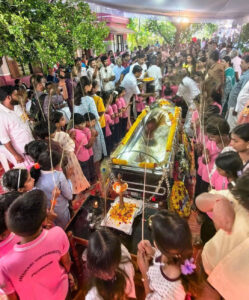 Hundreds of little children, carrying the blue peacock feather adorning the crown of Ambadikannan, chanting Hare Krishna Hare Rama. Aivarkala Puthanambalam in Kunnathur taluk of Kollam district bore witness to what was perhaps a rare ceremony in which the entire land came to bid farewell to a gifted personality who had written some of the most brilliant chapters in Kerala’s political, social and cultural life. At a time when children and young people had drifted away from culture and tradition, caught in the currents of atheism and existentialism and the rejection of Indian values amid the overwhelming influence of communist politics, the ceremony was a farewell to M. A. Sir. Who gave enduring prominence to the form of Krishna, the embodiment of the identity, values and life of Bharat and of dharma, love, compassion and mercy, from the Himalayas to Kanyakumari and from Kutch to Kamrup.
While he was the Chief Editor of Kesari weekly,the Malayalam organ of RSS, he named its children’s column Balagokulam. He interacted with the children of Kerala through their poems, mischief, writings and everything else, and gave it an organisational form. A cultural movement for the children of Kerala was started under the name Balagokulam. The children who gathered together once a week were drawn towards Indian values, tradition, culture and the treasure-house of knowledge. Kanna Muraleedhara, the prayer song of Balagokulam, became a new stream of vitality throughout the villages of Kerala. The Shobhayatra started under the auspices of Balagokulam in connection with Sri Krishna Jayanti has today become a wave in all the villages and major cities of Kerala. All the activities of Balagokulam, including the Sri Krishna Jayanti festival that turns the whole of Kerala into Ambadi, blossomed in the mind of the editor M. A. Krishnan, whom everyone called M. A. Sir. Today Balagokulam has become the largest children’s organisation or cultural movement in Asia. Thousands of children are becoming members of Balagokulam.
Today Balagokulam is the biggest undeclared enemy of all political movements in Kerala. All political movements, including the CPI(M) and Congress, are now considering ways to counter the activities of Balagokulam, which attracts children as a whole towards the Sangh Parivar movement. This time, when political leaders including the Congress mayor and MLA also joined the Sri Krishna Jayanti celebrations in Kochi city, one thing became clear, Balagokulam has transcended politics and become an expression of the people’s hearts and emotions. Balasangham, started by the CPI(M) against the activities of Balagokulam, is the children’s column of Deshabhimani. But Balasangham could not create any significant response in the face of Balagokulam’s brilliant course of activities. Until his death at the age of 97, M. A. Sir remained there as a Sangh pracharak, constantly observing the activities of Balagokulam, and Thapasya giving guidance and making reforms.
While studying Mahopadhyaya at University College, Thiruvananthapuram, he became attracted to Sangh activities and became a pracharak in 1954. Kerala has lost its oldest living pracharak. In 1964, following the instructions of the then Prant Pracharak Bhaskarraoji, he went to Kozhikode and took charge as editor of Kesari, thereby writing a new golden chapter not only in the cultural life of Malabar but of Kerala itself. He did not stop with starting Balagokulam. Realizing that Kerala’s literary and cultural sphere had become subservient to leftist decadence and was misleading the youth, and that neither the culture nor the values of Bharat were exerting any intellectual or emotional influence in the literary and cultural sphere, he formed an organization called ‘Tapasya’ to work in this field. During his activities in Kozhikode, he brought to the platform of Tapasya numerous literary figures and cultural leaders who came into contact with him, including former Mathrubhumi editor V M Korath, Thikkodiyan, Dr. Sukumar Azhikode, Akkitham, Olappamanna, and N N Kakkad. All the established writers of Malayalam literature, including K P Kesava Menon, M T Vasudevan Nair, O V Vijayan, Thakazhi, Uroob, M V Devan, S Guptan Nair, and S K Pottekkatt, came to the platform of Tapasya.
He made Tapasya’s activities vibrant during his underground life during the Emergency. A meeting organized in the name of a seventieth-birthday felicitation for V.T. Bhattathiripad turned into an anti-Emergency conference. With people including K P Kesava Menon participating and Bhattathiripad launching a fierce attack against the Emergency, the government was placed in a situation where it could do nothing. M A Sir was behind that as well. Behind M A Sir, the driving forces were the Sangh pracharaks themselves, P Parameswaran and P Madhavan. They were the trinity. Today, Tapasya has become an unavoidable cultural school of thought in Kerala. It was through M A Sir’s continuous work that the leftist brainwashing could be removed from Kerala’s intellectual sphere through cultural journeys and seminars that embraced the eternal continuity of the Bharatiya cultural stream. He was the one who opened up new paths for a culture of dialogue and pilgrimages to tradition. It was M A Sir’s work that brought Kerala’s literary and cultural leaders closer to the Sangh Parivar. From V.M. Korath, who beat his own brother until his stick broke because he went to a shakha, to O V Vijayan, who had leftist leanings, he brought everyone together and gave cultural Kerala a new mantra of harmony.
Due to health problems, he shifted his centre of activity to the Prant Karyalaya in Ernakulam, where too he remained active in the work of Balagokulam and Tapasya. He also became involved in the activities of the International Sri Krishna Centre. He served as the Sangh’s Prant Bauddhik Pramukh and as its first Prachar Pramukh. M A Sir, who never turned a cold face toward anyone and maintained a mind of empathy and tolerance toward everyone, was acceptable to all. His ability to express and resolve differences of opinion and problems without hurting anyone, and to keep people together, made him different. The thousands who flowed in from all parts of Kerala to a remote village in Kollam district were testimonials to his dedication to life and fragrant sacrifice.
He was born on January 17, 1929, at Ayivarkala in Kollam district. He was the son of Lakshmiyamma of Karimpinpuza Maravuthottathil and Padmanabhan of Ayirkala Mangalathu. He passed the Shastri examination from Kuzhikkalidavaka G.V.S.H.S.S. and Mahopadhyaya in logic from Maharaja’s Sanskrit College, Thiruvananthapuram. He worked as a teacher for one year at Vazhoor High School in Kottayam. He then resigned and became an RSS pracharak in 1954. He was a pracharak in Kottayam, Ernakulam, Alappuzha, and Kollam districts. Through series of articles on temples destroyed during Tipu’s invasion in Malabar and attempts at religious conversion, he awakened the people. Through the special issue titled The Legend of Nila, he raised his voice decades ago for the survival of the Bharathapuzha. M A Sir was also with V.M. Korath at the beginning of the Kerala Temple Protection Committee.
In 2008, he was honoured with the Vivekananda Seva Samman of the Badabazar Library in Kolkata. Numerous awards, including the Veerasree Veluthampi Memorial Seva Award, came to him. The Jnanayajnas of Balagokulam, the cultural pilgrimage led by Tapasya under the leadership of Mahakavi Akkitham from Kanyakumari to Gokarna, Balamahasammelanams, and many other movements in which M.A. Sir remained silently present are numerous. He was behind the social movement against taking the vapa by suffocating a goat during the Athirathrayaga conducted at Panjal according to Vedic culture, and against the Elavoor Thookkam in which people were suspended from iron hooks at the Elavoor temple. In a modern life where alcohol, drugs, and wayward living create excessive havoc, the gifted man who installed Kannan, the symbol of dharma, compassion, and love, along with the beautiful flute and the peacock feather on his crown, leaves behind memories of a golden age. That is his eternal memorial.
Academic Insight: The wave created by Balagokulam and Thapasya
Social Media Pulse: Viral response from all the walks of life
Article by: G K Suresh Babu