
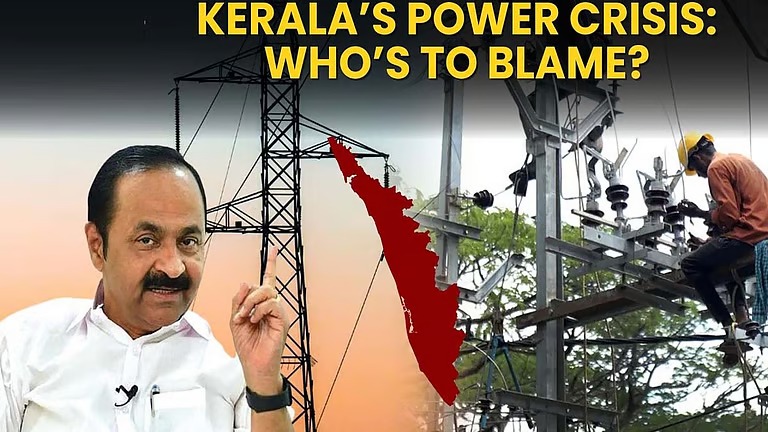
Kerala power crisis due to the laxity of the ruling fronts
Introductory Memo: Kerala is facing a growing electricity shortage as rising temperatures, humidity, reduced rainfall and increased demand have pushed daily consumption to around 100 million units, while dam water levels have fallen significantly compared with last year. The article argues that Kerala’s dependence on electricity purchased from outside the state has been worsened by delays in developing renewable energy and storage infrastructure, including floating solar plants, battery energy storage and pumped-storage projects. It highlights the rapid growth of solar power in India and says Kerala has not fully utilized schemes such as PM Surya Ghar, while several proposed solar, pumped-storage, thermal and hydroelectric projects have faced delays or opposition. Experts and former officials cited in the article attribute part of the present crisis to inadequate planning and delayed implementation by the state government and KSEB, while environmental concerns have also prevented some major hydropower projects. The article concludes that expanding household and large-scale solar generation, strengthening the electricity distribution network, developing battery and pumped-storage systems, and making better use of available central assistance could help Kerala reduce its dependence on outside power and address future electricity shortages.
Analytical view/ Analysis: The power crisis in Kerala is due to the failure of Kerala’s ruling fronts from the inception. No govt tried to tap solar energy while other states have a leap . Failed to establish thermal and atomic power units also.
As the rain decreased and the heat increased, electricity consumption in Kerala surged. The electricity consumption in a single day reached 100 million units the other day. The daily consumption had been 82.52 million units. The main reason for the increase in electricity consumption is that the daytime temperature in the state has risen by three to four degrees Celsius. Along with this, the increased humidity in the atmosphere made the heat more intense. The isolated rains that fell in some districts in recent days provided some relief. Kerala is currently facing a shortage of 1,000 megawatts of electricity per day. Although discussions were held with other states and electricity-generating companies, there has been no significant benefit so far. In addition, the reduced rainfall this time will pose a challenge to electricity generation in the coming days as well.
At the same time last year, the dams had 78.21 percent water. Now there is only 61.5 % water. This is likely to further affect the electricity situation in the coming days. Experts including Dr. R V G Menon have pointed out that the incompetence of successive governments in the state is the reason for the current electricity crisis. Although solar power generation at the national level has surged massively since Narendra Modi came to power, Kerala has almost failed to make use of it. India’s current solar power generation is 168040 megawatts. In 2014, it was only 3000 megawatts. India is now generating 1,23,000 megawatts of electricity through large solar parks. It is also generating 32500 megawatts of electricity from solar panels connected to the electricity distribution network and 4830 megawatts of electricity from hybrid projects. While states including Rajasthan and Gujarat made substantial use of the programme introduced by Narendra Modi, Kerala fell behind.
Rajasthan produces the most solar power in India. Gujarat is in second place. Kerala ranks twelfth in this regard. When Aryadan Mohammed was the electricity minister, preparations had been made to generate 7000 agard electricity by installing floating solar plants, including in the Idukki reservoir. Due to the inaction adopted by KSEB following the Saritha controversy, no one later attempted to implement this project. Now, including 1400 megawatts of Kuthippura solar power, 2200 megawatts of electricity is being generated in Kerala from solar plants alone. To generate this much electricity, the State Electricity Board would have had to spend at least 10,000 crore rupees. This much electricity was generated in Kerala through the PM Surya Ghar scheme with central subsidy and by investing its own money. But the State Electricity Board also failed to arrange a system to store this electricity and use it during peak times.
The central government is providing large-scale financial assistance to establish such battery-based energy storage systems. Using this, efforts are underway to establish 5 battery energy storage systems with a capacity of 340 megawatts, or bus, across the districts of Kasaragod, Malappuram, Alappuzha, and Thiruvananthapuram. Former chairman Dr. Biju Prabhakar and Dr. R B G Menon among others point out that this has been delayed considerably. Experts had pointed out at a seminar organized by the Energy Management Centre that if a pump storage system, in which the water used to generate electricity in the dam is pumped back for reuse, had been implemented in Kerala, an additional 5000 megawatts of electricity could have been generated. This system could have been effectively implemented at Peringalkuthu, above the Athirappilly project that could not be implemented due to environmental concerns. Experts point out that 350 megawatts of electricity could have been generated from this.
Biju Prabhakar, former chairman of the Electricity Board and former IAS officer, also states that the current crisis is a disaster created by the Electricity Board itself. It took 15 years to complete the Thottiyar power project. The cost of 1700 crore rupees was borne by the central government and 50 crore rupees by the state government. Experts unanimously point out that despite the central government providing such generous assistance, Kerala has not been able to make use of it or resolve the electricity crisis. There was a plan to install a battery system capable of storing 2000 megawatts of electricity at the Kayamkulam thermal power station. This too could not be utilized. Ten years ago, a contract was signed to purchase 465 megawatts of electricity for 8000 crore rupees. This was cancelled when Pinarayi Vijayan was the Chief Minister. The cost currently estimated is thirteen thousand crore rupees. This could rise to 16000 crore rupees.
There is a shortage of twelve thousand megawatts of electricity across the country. Kerala is facing a shortage of 1750 megawatts of electricity. As electricity consumption increases, this is likely to rise in the coming days. It is not easy to start hydroelectric projects by destroying Kerala’s natural forests and rivers with their unique features. Pooyamkutty, Silent Valley and Athirappilly are projects that were stalled due to opposition from environmental activists. The aim was to generate 163 megawatts at Athirappilly and 240 megawatts at Pooyamkutty and Silent Valley. These hydroelectric projects were abandoned on the basis of taking the position that projects were not needed if they meant destroying Pooyamkutty, which has some of the world’s rarest flora and fauna, the Athirappilly forest region, one of the rarest rainforests, and elephant corridors, and convincing people of this position. Meanwhile, the National Thermal Power Corporation was ready to build a coal-fired thermal power plant at Cheemeni in Kasaragod district. The nuclear power plant that was intended to be started at Peringome is the one that was eventually established at Kudankulam in Tamil Nadu.
The argument put forward at the time by environmental activists and organisations including Kerala Sasthra Sahithya Parishad was that if a nuclear plant were established in Kerala, any accident or disaster would affect the whole of Kerala. Experts point out that since that nuclear plant was established at Kudankulam, just 40 kilometres beyond Kerala’s airspace, any disaster would affect Kerala the most. If this thermal power plant or nuclear power plant had come to Kerala, there would not have been the electricity crisis being faced today. Today, Kerala buys 78 % of the electricity it needs from outside the state. The current crisis can be resolved by installing floating solar plants in rivers including the Idukki and Mullaperiyar and generating solar power on a large scale, and by widely implementing a bus system to increase electricity storage capacity.
Another way is to strengthen the system for transmitting solar power to the Electricity Board’s distribution network. There is widespread criticism that the State Electricity Board is turning its back on schemes including the Prime Minister Surya Ghar scheme. Although the central public sector undertaking Tehri Hydro Development Corporation prepared a project to generate 6155 megawatts of electricity without the state government spending even a single rupee, the project stalled because the state government has not taken a decision so far. In 2022, when Pinarayi Vijayan was Chief Minister, the central institution approached Kerala to generate 6155 megawatts of electricity through 13 pumped storage projects. They had also offered an investment of more than 36000 crore rupees at a rate of six crore rupees per megawatt. They were also ready to supply electricity to Kerala from the project at a cost of only about 4.5 rupees per unit. In addition to the state government receiving royalty tax revenue of five paise for every unit of electricity generated, the project also offered employment opportunities and tourism potential. It is said that although a Malayali Special Officer came to Kerala 30 times in connection with this project, officials in the state government and Electricity Board obstructed it.
However, former minister K Krishnankutty explains that the problem was that by the time the state government became ready for this, the term of the cabinet had ended. While Kerala turned away, the states of Tamil Nadu, Andhra Pradesh, Uttarakhand, Gujarat, Bengal, Telangana and Maharashtra established storage projects to generate 7425 megawatts of electricity through the central public sector Hydro Development Corporation. The lack of diligence and sense of purpose shown by the state government and Electricity Board in solar power projects and pumped storage projects is the reason for today’s electricity crisis. The subsidy for the Prime Minister’s solar power scheme will end this year. Only if, before it ends, all the villages and households in Kerala are brought into the solar power scheme, a system is arranged to transmit the electricity generated from it to the distribution network, and the pumped storage project is implemented on a war footing, can the electricity crisis Kerala is facing today be resolved. What remains to be seen is whether the state administration will show the political will for this.
Meanwhile, there are indications that an agreement has been reached to purchase electricity from Himachal Pradesh at a rate of Rs. 14.5 per unit. The state government says that if Himachal electricity becomes available, it will resolve Kerala’s power crisis. The Union Ministry of Power also maintains that the only way to find a permanent solution to Kerala’s power crisis is to start a thermal power plant or a nuclear power plant. The central government has also given a proposal to start a coal-fired power plant, that is, a thermal power plant.
Reference
- https://www.thehindu.com/news/national/kerala/political-blame-game-over-power-crisis-intensifies-between-keralam
- https://www.newindianexpress.com/states/kerala/2026/Sep/12/power-crisis-deepens-as-kseb-hits-supply-wall
- https://english.mathrubhumi.com/news/kerala/kerala-power-cuts-kseb-himachal-electricity-eebpg8yy
- https://www.thenewsminute.com/kerala/kerala-electricity-crisis-himachal-pradesh-signs-deal-with-kseb-offers-temporary-relief
- https://www.deccanchronicle.com/southern-states/kerala/keralam-power-crisis-govt-oppn-trade-charges-over-shortage-1986939
- https://www.newindianexpress.com/states/kerala/2026/Oct/08/respite-for-power-starved-keralam
- https://share.google/nRk2xciexEislXIl1
- current undo https://share.google/CXSAmO8KsJw3DhQ0J
- YouTube https://share.google/dK8bTzix77jC3CT9B
- The New Indian Express https://share.google/qMQGAjU2jUgdLYAlA
News at a Glance: Kerala is facing acute power shortage. Undeclared power cut is happening daily and affecting the public life.
Academic Insight: The failure , corruption and lethargy may be exposed so as to induce a political change
Social Media Pulse: Viral response in social media and certain videos depicting CM were deleted by Meta
On Our Reading List: Mathrubhumi, Manorama, Indian express, Times of India, Deshabhimani, Janambhumi
Article by: G K Suresh Babu