
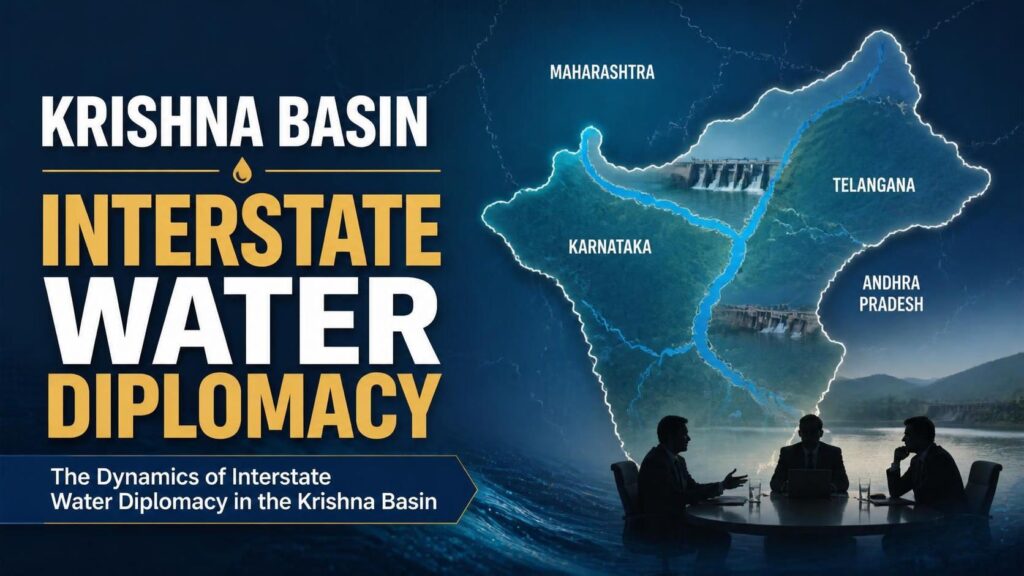
The Dynamics of Inter-State Water Diplomacy in the Krishna Basin
TL;DR
Following high-level ministerial meetings in Bengaluru, Karnataka assured a phased release of 3 TMCft of Krishna water to help Telangana salvage standing Kharif crops across 5.5 lakh acres. However, localized resistance from farmer associations in North Karnataka quickly forced an operational halt, underscoring how ad-hoc inter-state political arrangements buckle under domestic agrarian pressure in the absence of a legally binding distress-sharing formula.
Introductory Note:
Facing late-monsoon dry spells and depleted reservoir levels, standing Kharif crops across Telangana’s erstwhile Mahabubnagar (Palamuru) region were on the verge of withering, threatening the livelihoods of lakhs of farming families. With storage at the Priyadarshini Jurala Project dwindling to critical drinking water buffers, a high-level ministerial delegation from Telangana rushed to Bengaluru to request an emergency discharge from Karnataka’s upstream Narayanpur reservoir.
While Karnataka initially extended assurances to release water on humanitarian grounds, domestic resistance from farmer organizations in its own Kalyana-Karnataka belt—who feared that local tail-end canals and the upcoming Rabi crop cycle would be jeopardized—forced an operational pause and curtailment of downstream flows. The sudden halt sparked friction between the two riparian states, highlighting the limitations of seasonal water management governed by informal political understandings rather than institutional rule curves.
Analysis / Analytical View:
The Telangana delegation including Tourism Minister Jupally Krishna Rao and MLA Vakiti Srihari met Karnataka leaders on September 23, 2026, in Bengaluru, requesting an indent of 5,000 cusecs daily for 30 days (~13 TMCft) from the Narayanpur reservoir. Karnataka offered an assurance to release roughly 3 TMCft in phased, rotational (“on-and-off”) tranches to support downstream farmers. Relying on this commitment, Telangana irrigation authorities opened the Jurala canal gates to deliver water to parched fields.
However, the arrangement met with immediate operational friction. Farmer collectives and local leaders across North Karnataka—particularly in Raichur, Yadgir, Bagalkote, and Vijayapura—raised strong opposition against depleting upper Krishna storage. They argued that domestic reservoirs must prioritize regional drinking needs and the forthcoming Rabi season before feeding downstream systems. Consequently, upstream releases were throttled, leaving Jurala with minimal fresh replenishments.
The impasse created political fallout in Telangana, where opposition parties criticized the state administration for depending on fraternal party goodwill instead of securing formal indents through the Krishna River Management Board (KRMB) or approaching the Supreme Court. The development illustrates a structural gap in Krishna basin governance: while tribunal awards specify volumetric annual quotas, they lack binding, sub-seasonal distress-sharing mechanisms when rainfall distribution turns erratic.
News at a Glance:
Karnataka Assures Krishna Water Release, Telangana Opens Jurala Gates for Farmers
Karnataka Agrees to Release Water to Telangana’s Jurala Project in Phases
https://telanganatoday.com/karnataka-agrees-to-release-water-to-telanganas-jurala-project-in-phases
Karnataka To Give Additional Krishna Water To Telangana
జూరాలకు కర్ణాటక నీళ్లు! (Karnataka Agrees to Release Water to Jurala)
Social Media Pulse:
https://youtu.be/gFNTbwmgVRg?si=xsL446Pm969Ho4r8
https://youtu.be/rrmLrUKq7KY?si=BtwZNwL_Szbl5wKF
https://www.facebook.com/share/v/1FREEvuzBm/
By Numbers:
Telangana Requested Indent: 5,000 cusecs daily for 30 days (13 TMCft).
Karnataka Phased Commitment: 3 TMCft agreed in rotational tranches.
Command Ayacut at Stake in Telangana: 5.5 lakh acres across four major lift and gravity irrigation schemes.
Lift Irrigation Schemes Reliant on Storage: Nettempadu, Bhima, Koilsagar, and the Priyadarshini Jurala Project network.
Almatti Reservoir Storage at Time of Talks: 117.77 TMCft against 129.72 TMCft gross capacity.
Initial Narayanpur Outflow Rate: 11,403 cusecs released toward downstream courses during peak discussions.
Conveyance Transit Distance: 180 km river course from Narayanpur Dam to Jurala Reservoir.
Our Reading List:
The Krishna Water Disputes Tribunal (KWDT-II) Final Award & Further Report: Ministry of Jal Shakti, Government of India (governing Almatti and Narayanpur operational guidelines). Further References under Provisions of ISRWD Act, 1956 before the Tribunals | Central Water Commission, Ministry of jal shakti, Department of Water Resources, River Development and Ganga Rejuvenation, GoI
Gazette Notification on the Jurisdiction of the Krishna River Management Board (KRMB):Ministry of Jal Shakti, Government of India (outlining statutory authority over inter-state project regulation). Press Release:Press Information Bureau
Transboundary Water Politics and Hydro-Hegemony:Mark Zeitoun & Jeroen Warner, Hydro-hegemony – a framework for analysis of trans-boundary water conflicts, Water Policy (examining upstream riparian leverage). Hydro-hegemony – a framework for analysis of trans-boundary water conflicts – University of East Anglia
Integrated Water Resources Management in Peninsular River Basins: Central Water Commission (CWC) River Basin Planning | Central Water Commission, Ministry of jal shakti, Department of Water Resources, River Development and Ganga Rejuvenation, GoI & International Water Management Institute (IWMI) Research Reports.
- PAYYAVULA JAGATHKRISHNA