As the CPM towards Hindutva
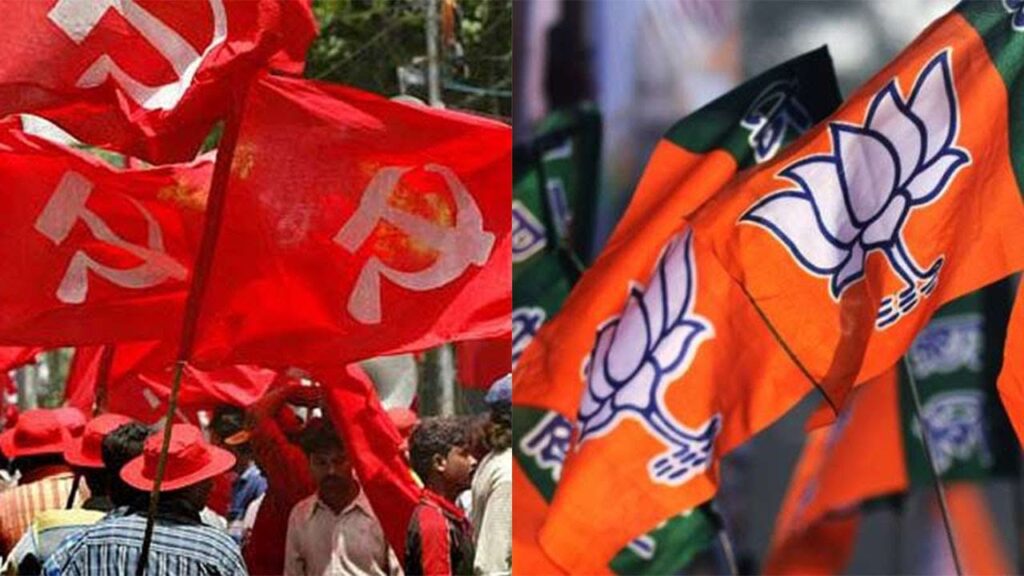
Introductory Memo: The CPI(M)’s expanded state and district conferences in Kerala have identified the BJP’s growing influence as a serious ideological and organizational challenge, noting its rise from 12.47% of the vote in 2021 to 14.2% in 2026, its second-place finishes in six constituencies, and its growing ability to attract Left and secular voters through Hindutva-based mobilization of caste and religious groups. The party has concluded that the BJP-RSS cannot be defeated through elections alone and has called for stronger ideological work, outreach to believers and intellectuals, greater participation in public festivals, and efforts to counter communal polarisation. At the same time, the CPI(M) has acknowledged internal weaknesses, including declining votes in many constituencies, inactive members, factional disputes, weak participation in struggles, inadequate ideological training and the effects of being continuously in power for a decade. It plans to reduce the number of full-time workers, encourage professionals to work in their respective fields while remaining active in the party, strengthen political education and attract people with stronger public credibility. The party also noted that 55% of its members joined after 2016 and 83% after the Soviet Union’s collapse, leaving many without experience of opposition or revolutionary activity, while women and youth participation has increased significantly. Overall, the CPI(M) is seeking a major organizational and ideological renewal while preparing for a stronger political struggle against the BJP and a new front against the UDF government.
Analytical view/ Analysis: CPM is turning towards once stranded Hindutva ideology. Now they realizes that avoiding Hindutwa is the cause for overwhelming defeat of CPM in Kerala. In order to avoid criticism decided to reduce the number of full time workers also.
The CPI(M) assessment is that the BJP emerging as the third force in Kerala’s political arena is a serious ideological problem. This has been clearly indicated in the reports submitted at the expanded district conferences that began in the districts following the expanded state conference. The party document and the general discussion assess it as serious that the BJP not only won and grew in the Chathannoor, Nemom and Kazhakkoottam constituencies, but also created influence in Left strongholds and secured Left votes. The BJP, which received 12.47 percent of the vote in the 2021 Assembly election, received 14.2 percent of the vote in 2026. The BJP adopted a policy of mobilizing small caste and religious groups and bringing them together on the basis of Hindutva. The secular votes that the CPI(M) had received earlier did not come to the CPI(M) in this election. The BJP came second in six constituencies. These are Manjeshwaram, Kasaragod, Malampuzha, Palakkad, Thiruvalla and Attingal. The fact that this includes CPI(M) strongholds as well must be viewed seriously.
The party document also says that the BJP is adopting an approach of dividing Hindu groups along caste lines and uniting them communally. The BJP is also adopting a policy of giving money to caste organizations and encouraging their activities. The attempt is to line up such organizations that are becoming active under the Hindutva banner. Strong interventions are also being made to bring CPI(M) workers into the BJP. The BJP-RSS Parivar alliance cannot be isolated or defeated through electoral battles alone. Over the past 10 years, Hindutva forces have built a strong base on the basis of their ideological influence. The party document suggests formulating comprehensive programmers to resist this in view of the situation. The party document suggested reaching out to believers to counter the increasing influence of the Sangh Parivar in temples and festivals, among other places, and to restore the public character of celebrations.
The expanded state conference assessed that the instruction given to party workers at the Palakkad Plenum to keep away from temple affairs had distanced Hindu believers from the party. There was an assessment that the party should make conscious interventions to make all festivals and celebrations common to and belonging to all sections of people. In this sense, the state committee suggested expanding activities among Sanatana Dharma Hindutva believers. Separating all celebrations into watertight compartments belonging to particular religious groups by citing ritual matters turns the public space into a private space. A suggestion was made to intervene to prevent the creation of an atmosphere of religious hatred and hatred of the other. When the question arose whether Krishna Jayanti and Vinayaka Chaturthi should be celebrated by party workers, the initial response was that it was not intended that the party should celebrate them, but CPI(M) state secretary M V Govindan responded that Krishna Jayanti was not the monopoly of the RSS and that it could also be considered if desired. The state secretary explained that when P Jayarajan organized the Krishna Jayanti celebration, the party did not support it because there had been no decision on how it should be done and at which levels. The party document criticizes the major shortcomings that remain in exposing right-wing ideology and propagating the Left perspective.
Ideas that Marxist ideology is outdated are being propagated. The view that each section should organize with an identity-based perspective and secure its rights is also gaining strength. Some quarters are putting forward the idea that organizing oppressed sections along caste and communal lines is progressive. In this situation, special attention should be paid to propagating Marxist ideas effectively in universities and research fields. Intellectual sections should also intervene most actively to bring the middle sections closer to the party. The state committee has also suggested making conscious efforts to bring more intellectuals and social and cultural activists closer to the party. There was also a suggestion that party workers should seriously assess the changes in the voter list. Votes declined in 88 constituencies in the Assembly election. Votes increased in 52 constituencies. Most of the constituencies where votes increased are in northern Kerala. A suggestion was made that variations in votes would affect the balance of strength in the constituencies and that party workers should also monitor this.
Meanwhile, there was no change in the secretaries in the Alappuzha, Thiruvananthapuram and Thrissur districts, where the expanded district conferences were held. Expanded district committee meetings were also completed in Thrissur, Palakkad, Kozhikode, Idukki and Pathanamthitta districts. Palakkad district secretary N Suresh Babu was removed and Chenthamarakshan was made district secretary in his place. Although it is being said that the district secretary was removed over a sexual harassment complaint raised by a woman lawyer, there has been no official explanation regarding this. In Alappuzha, remarks against G Sudhakaran opened a new front of conflict and moved towards a situation of enumerating the party’s shortcomings. The district committee’s assessment is that there was indeed a failure in handling G Sudhakaran’s issue. Thiruvananthapuram called for regaining the party’s influence and organizational strength. It was decided to include 10 people as invitees to the district committee. The report presented at the district conference said that 30 % of the party members in the district are inactive and that they should be given political education and made active in party activities. In Thrissur, former DYFI state president T Sasidharan was not considered again for the district secretariat. Instead, Democratic Women’s Association leader Usha Prabhukumar was included. K Sasidharan, who had been expelled from the party district committee for one year on the grounds of factionalism, was taken back after 14 years. Sasidharan, a known V S faction member, was favoured by the official group including Pinarayi. The district committee was expanded by excluding one person for health reasons and including eight people. A section has again come forward over the non-inclusion of Sasidharan in the district secretariat.
Number of full-time workers to be reduced
The CPI(M) has decided to undertake a major overhaul of its ideological propagation and organizational system and reduce the number of full-time workers. The extended state conference held in Kozhikode focused on correcting the party. At present, around 6129 full-time workers are active in the party and mass organizations in Kerala. At the national level, there are around 11000 full-time workers. The majority of them do not have other jobs. The move is to deploy those who can take up other occupations in their respective fields and convert full-time work into part-time organizational activity. It has been found that having more full-time workers unemployed and working within the party leads to allegations and improper financial transactions. There are now many professionals, including lawyers, within the party system. The assessment is that if all of them are allowed to pursue their own professions and devote the remaining time to organizational work, they can also gain influence in their respective professional fields. It will also be possible to reduce the large amount the party spends on full-time workers. The party is also considering identifying and bringing in more workers with a better public image.
There has also been an assessment that the lack of experience and exposure among CPI(M) workers is seriously affecting the party system. 55 percent of the party’s members have no experience of working while in opposition. The party also assessed that 83 % of its total membership has no experience in militant revolutionary activities. The finding of the extended state conference was that serious work within the CPI(M) is essential to mold them into workers based on a genuine ideological foundation. The membership in Kerala is 563,000. During the four years preceding the last party congress, the party’s membership declined significantly. In 2021, the membership was 527174. Although it rose to 574261 in 2022, it fell to 567123 in 23. In 2024, it declined again to 564895. The assessment is that being continuously in power for the past 10 years weakened the party’s fighting spirit and organizational system.
The failure to attract people and the weak participation in agitations and other programs organized by the party are also a headache. 55 percent of the party’s membership consists of people who became party members after 2016. Therefore, they have neither worked in opposition nor participated in agitations during the past 10 years. The CPI(M) is now trying to overcome this crisis. Over the past 10 years, only a handful of agitations have been held against the central government. Moreover, 83 percent of party members joined after the collapse of the Soviet Union in 1991. CPI(M) leaders point out that the fact that none of them has any understanding of revolutionary activities is a serious problem facing the party. Compared with 2021, the party’s membership has increased in 2025. The participation of women and youth has increased significantly. During this four-year period, 28,000 women newly joined the party. Earlier, women accounted for 19.8 % of party members. This increased to 22.8 %. Youth membership, which was 23.79 in 2021, increased to 29.8% by 2024. The party assesses that there has also been significant progress in class-based mass organizations. Trade union membership is 31.06 lakh. The farmers’ organization has 67.70 lakh members. There are 27.07 lakh agricultural workers, 59.87 lakh women, 52.16 lakh youth and 16.63 lakh students. The move is to build a strong organizational foundation through a new front of struggle against the UDF government in Kerala and through party classes.
Reference
- 24 News https://share.google/ETcNCKaPJvOpEwe7v
- Mathrubhumi https://share.google/5VWNs1zEtjYaAyHeT
- Mathrubhumi https://share.google/QSrsEJxQuXYdZAKzn
- YouTube https://share.google/112rAfhnvw1UlQJVO
- The New Indian Express https://share.google/IUOkQeP9TujBDvRhj
- The New Indian Express https://share.google/w1VLooovmxVs0vOJf
- YouTube https://share.google/SMKZP7CQZ8F84lyz0
- NDTV https://share.google/0gdtPDXNe24I9sCtW
News at a Glance: CPM coming back to temples and Hindutwa to regain the support base. They are trying to forbid the growth of BJP in Kerala
Academic Insight: CPM effort will initiate political clashes in temples and Hindu festivals.
Social Media Pulse: The efforts of CPM is criticized in social media
On Our Reading List: Mathrubhumi, Manorama, Indian express, Times of India, Deshabhimani, Janambhumi