
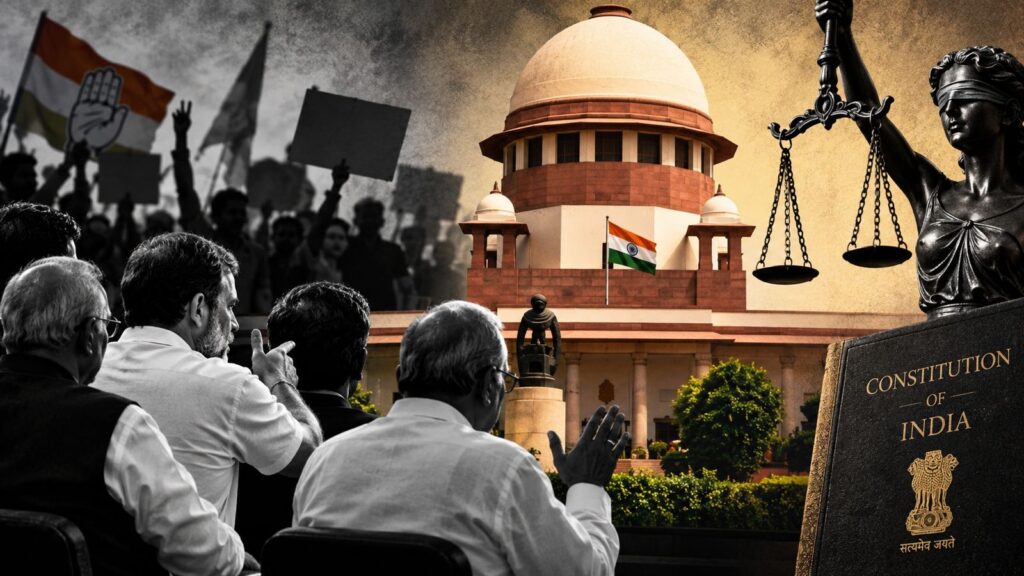
Supreme Court’s late night sitting for terrorists and anti-nationalists is a curse to judiciary
Introductory Memo: The Supreme Court for holding late-night and special sittings to hear petitions involving high-profile terrorists,political figures and activists, arguing that such urgent legal relief is selectively granted to anti-establishment elements while ordinary Indian citizens suffer from severe delays and systemic injustices. Contrasting these midnight hearings with the staggering backlog of millions of pending cases in Indian courts—where common people, under trials, and victims in POCSO and false-accusation cases wait years or decades for justice—the text questions the neutrality and priorities of the judiciary, asserting that judges should instead focus their time and resources on clearing ordinary pendency.
Analytical view/ Analysis: How the special privilege of Supreme Court’s late night sittings are focused and vested only to terrorists and Anti-National forces? The time is came out to question the neutrality and priorities of judiciary. Now also following the colonial standards of vacation and work ethics on one side and piling up the cases on other side. The justice denied to ordinary citizens of India are given to anti nationals by late night sitting is a curse to judiciary.
No BJP member, RSS worker, or Sangh Parivar activist has ever said today that they have no faith in the Supreme Court or the judiciary. When Indira Gandhi attempted to bring the judiciary under her control during the Emergency, the Jan Sangh—the precursor to the BJP—and the Sangh Parivar movements were there to resist and counter it. Recently, while the Left-Jihadi axis led protests cantered around Jantar Mantar aimed at destabilizing India, undermining the credibility of constitutional institutions, and overthrowing the government through revolution, Prashant Bhushan once again reiterated his lack of faith in the legal system. Amidst this, the Supreme Court held a night sitting against the restrictions imposed by the Delhi administration to ensure law and order in the national capital and to curb the protests of anarchists.
On Sunday night, October 11, a bench comprising Justices Joymalya Bagchi and Chief Justice V. Mohanan heard the petition filed by opposition organizations. The demands raised included releasing those taken into preventive detention due to law and order issues and restoring the metro and internet services. The court also initiated contempt of court proceedings against the Union Home Secretary, the Delhi Police Commissioner, and the DMRC for shutting down metro services in the wake of the protests.
Is this midnight sitting by the Supreme Court legal? When anti-national forces, with the help and financial backing of foreign powers, unleash anarchy to stage a bloody revolution and destabilize the government against the nation, the judiciary has a responsibility to satisfy ordinary taxpayers as to what circumstances warranted holding an illegal midnight court session to abet it. The biggest issue troubling the general public is that this late-night Supreme Court sitting was ostensibly not in the interest of India. On July 29, 2015, at 2:00 AM, the Supreme Court similarly heard a petition. That was to evade the death penalty of Yakub Memon, an accused in the 1993 Mumbai blasts case. The public raised the question: why did the open court, responding to the demands of terrorists who waged war against the nation, fail to see the tears of innocent and helpless ordinary Indian citizens who lost their lives?
The next notable late-night sitting took place on July 1, 2023. This night sitting was held for Teesta Setalvad, who had hounded Narendra Modi in Gujarat. Zakia Jafri and Teesta Setalvad were at the forefront of the case alleging Narendra Modi’s involvement in the Gujarat riots, which reached all the way to the Supreme Court. The Special Investigation Team appointed by the Supreme Court was led by former DGP K. R. Raghavan. Widely regarded as one of the most honest and finest officers in the Indian Police, he investigated the involvement of Prime Minister Narendra Modi and three others. After examining witness testimonies, documents, and telephone records, it was found that Modi had no connection whatsoever with the incident. A three-judge bench led by Justice A. M. Khanwilkar considered the report. The bench observed that Teesta Setalvad had filed the case with malicious intent. Her attempts to fabricate false documents and evidence were highlighted in the verdict. The Special Investigation Team had also found attempts made to create and coach false witnesses. Citing this, the Supreme Court very clearly found that conspiracy, forgery, and creation of false evidence had taken place in this matter. Based on this, she was arrested on June 25, 2022. Following the denial of bail including by the High Court, a bench presided over by Chief Justice U. U. Lalit granted her interim bail in September. When her bail petition was filed again, the Gujarat High Court dismissed it on July 1, 2023, and ordered her surrender immediately. That same evening, the Supreme Court considered her bail plea. Although the case was heard by a bench comprising Abhay S. and O. K. Prashant Kumar Mishra, due to a divergence of opinion, Chief Justice Chandrachud referred the petition to a three-judge division bench. A bench comprising Justices B. R. Gavai, A. S. Bopanna, and Dipankar Datta held the sitting at 9:15 PM. Staying the High Court order, the Supreme Court granted her bail. The case was heard again on July 19, and regular bail was also granted.
Following that, this is now the third case where a night sitting has been held. The general assessment is that holding these three cases for anti-national forces calls into question the neutrality and honesty of the court.
Should not the judicial community itself ponder whether it is appropriate for the neutrality of justice to grant late-night sittings to anarchists—a privilege not afforded to ordinary citizens of India? In Kerala, a woman named Sheela Sunny, who was arrested in a fake drugs case, was kept in custody for 72 days. The court later found that the case and evidence were fake.
Rules stipulate that trial in POCSO and rape cases must be completed within one year. About two hundred thousand cases are pending in the POCSO-rape category. How anarchists manage to get justice denied even to children is something the Supreme Court should consider.
According to data from October 2026, 95,977 cases are pending in the Supreme Court. Of these, 73,447 are civil cases and 22,554 are criminal cases. Among them, ten thousand cases are more than 10 years old. Five hundred are more than 20 years old, and 26 cases are more than 30 years old. As of October 6, a total of 59 million cases are pending across India. Of these, 180,000 cases are 30 years old. There are 52.4 million cases in district courts and 6.532 million cases in high courts. In half of these cases, governments are the complainants, and 20% of the cases relate to land and property. India’s courts have the highest number of pending cases in the world. Experts say that even to dispose of the existing cases at the current rate would take 324 years. It also deserves special attention that in many of these cases, justice is denied or innocent people are punished. On April 22, 2026, the judiciary itself pointed out that a man released by the Bihar High Court due to lack of evidence had spent 28 years in prison despite being innocent.
If the judges who hold late-night sittings for terror accused, anti-national forces, and anarchists had instead held an extra sitting one day a week, they could have delivered judgments on the majority of the pending cases. It is in this context that opposition to the night-time special sittings of the Supreme Court has arisen in the public sphere. It is impossible to ignore the widespread criticism that has emerged on social media against the Supreme Court’s night-time special sittings. Those who conducted the night-time sittings must answer the question: why should the consideration given only to Yakub Memon, Teesta Setalvad, Abhijit Deepak, and Neha Bora not be extended to the common people of India?
Reference
Supreme Court Observer https://share.google/A6GpD7MUjYwgox2XH
Supreme Court of India https://share.google/9K5xNvzEwwOP7MJJE
Supreme Court of India https://share.google/9r9lvncMHMcxMrjj9
Supreme Court of India https://share.google/Np5dJwWz6UBxndp90
Facebook https://share.google/OhDU4haSz1CCpLlQM
Business Standard https://share.google/YOFAMdYW1I4UofiQ8
News at a Glance: All the late night sittings of the Supreme Court were for either terrorists or for anti nationals
Academic Insight: The partisan move of the judiciary and lenience to terrorists and anti nationals is a subject to be studied.
Social Media Pulse: Viral in the case of late night sitting for Delhi protestors
On Our Reading List: Mathrubhumi, Manorama, Indian express, Times of India, Deshabhimani, Janambhumi
Article by: G K Suresh Babu