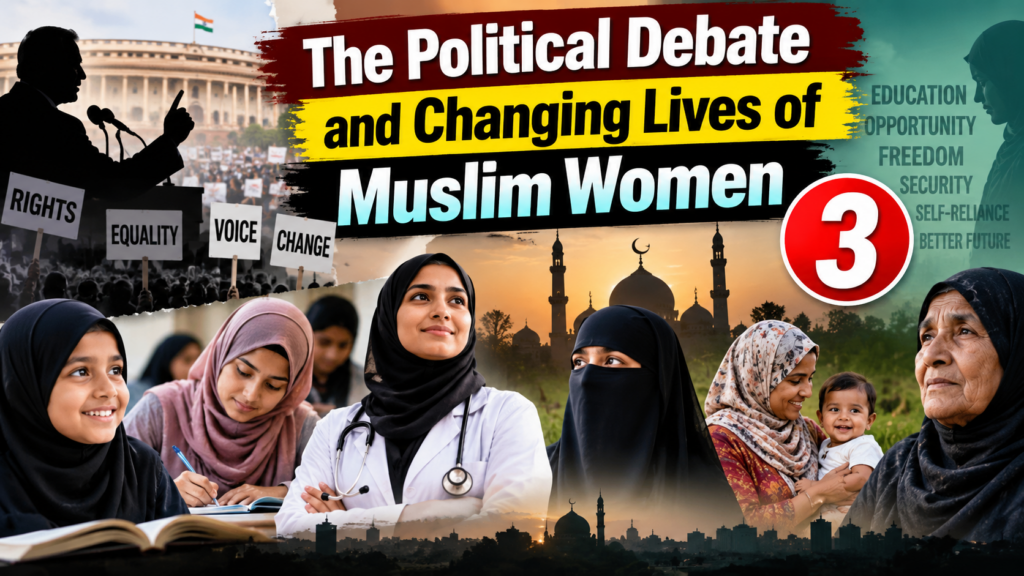
The political debate and changing lives of Muslim women – 3
Who Decides the Freedom of Muslim Women?
The debate over Muslim women’s freedom is not confined to Kerala. It has a wider historical and constitutional context.
A new Jasmine Revolution is unfolding in different parts of the world, with Muslim women challenging restrictions associated with hijab and purdah and asserting their freedom and independence.
In India and Kerala Muslim women continue to face restrictions despite Kerala’s high levels of female literacy and education. Kanthapuram A P Aboobacker Musliyar’s statement need to be seen as part of the continuing debate rather than as an isolated remark.
Kanthapuram has also argued that India is a secular country in which the Constitution guarantees citizens the right to profess and propagate their religions. However, he was forgetting the limits placed on religious practice by the Constitution and by recent judicial observations. The Chhattisgarh High Court and the Supreme Court made it clear that Sharia law does not stand above the Constitution and that Indian law remains the final legal authority for citizens.
The Constitution envisages equality and equal opportunity for women and men. This raises a fundamental question: what authority can a religious leader exercise to deny women rights guaranteed by the Constitution on the basis of a religious interpretation?
“How many people remember Abadi Banu Begum, who abandoned purdah and participated in the freedom movement? Begum Nishatunnisa Mohani, editor of Urdu-e-Mulla who called for Purna Swaraj? Ashghani Begum, who led armed fighters during the 1857 uprising? Moon Dar, who served as a bodyguard to Rani Lakshmibai; and Bibi Amtus Salam, who went to prison as part of the freedom struggle?”
The Muslim women’s participation in public life is not alien to Indian or Muslim history.
The Kerala experience since the 1990s is something different. The full-body purdah and burqa became more common in Kerala during this period and the reason is the influence of fundamentalist organizations, including SIMI.
The role of the Muslim Educational Society, or MES, which advocated education, freedom, progressive clothing and equal opportunities for Muslim girls should not be forgotten. Such progressive voices subsequently faced pressure from fundamentalist organizations.
Hundreds of publications and religious interventions were used to reinforce restrictive interpretations of women’s roles. These campaigns sought to discourage women from going out freely, choosing their clothing, travelling alone, studying or working. Efforts were made to portray Muslims as being under threat and to use communal tensions and the demolition of the disputed structure in Ayodhya as part of this narrative.
In a pluralistic country such as India, the challenge is to preserve respect for different religions while preventing any religious interpretation from being imposed as a restriction on another citizen’s constitutional rights.
It also recalls opposition to women’s education and restrictions that, according to the article, have been imposed on Muslim women in Kerala, including restrictions on travelling alone, appearing in public, dancing and singing.
Muslim girls participated in the celebrations despite religious injunctions against them. They wore Kerala’s traditional kasavu attire with headscarves, sang Onam songs, made flower carpets, ate the feast and danced. From Kasaragod to Parassala, they celebrated alongside members of other communities.
The participation spread through social media and became a visible symbol of young Muslim women’s assertion of their place in Kerala’s public and cultural life. This has provoked Kanthapuram and Jifri Thangal and that the subsequent call for women to remain confined to their homes represented an attempt to restore restrictions that the girls had visibly challenged.
But the social circumstances of today are very different from those of the Prophet’s lifetime. Science, technology, transportation, education and women’s participation in employment have transformed society.
The issue rose many questions that needs answers: What is wrong with a girl studying, getting a job and becoming financially independent? What is wrong with a woman claiming the same constitutional freedoms as a man while continuing to practice her religion? What is wrong with women demanding equality in marriage, maintenance, property and other areas of family life?
In a secular democracy, can any religious leader decide that women do not possess the equality guaranteed to them by the Constitution?
When the Constitution opens the boundaries of a vast public sphere, Muslim women must decide whether they want to remain within the walls of the home. It is they, who must determine their freedom and their path.
Meanwhile, Kanthapuram subsequently issued another statement saying that Islamic religious rulings cannot be altered or withdrawn to suit an individual or a political party.
Malaysian Prime Minister Anwar Ibrahim, who visited Kanthapuram, did not endorse his position and said scholars should recognize new realities.
The controversy, therefore, remains larger than one statement or one circular. At its centre is an unresolved question about religious interpretation, constitutional equality and the right of Muslim women to determine the course of their own lives.
(Concluded)