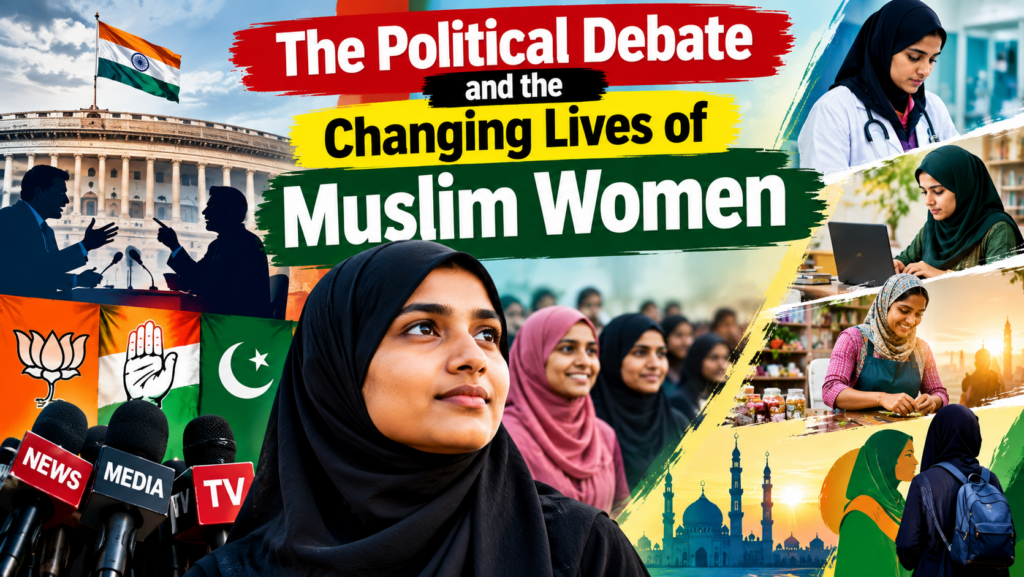
The political debate and changing lives of Muslim women – 2
UDF Succumbing to Religious Fundamentalism?
The controversy soon moved beyond the original statement and became a political confrontation.
The extremist faction within Samastha and one faction of the Muslim League came out against Chief Minister V. D. Satheesan, who took a strong position against Kanthapuram’s remarks. The statement and the reactions from Muslim organizations and leaders opened a wider discussion about the lives, living conditions and education of Muslim women in Kerala.
Although Satheesan initially remained silent, he later criticized Kanthapuram at a press conference following a Cabinet meeting. He said the argument that women’s entry into the public sphere would cause great destruction belonged to the 19th century.
Satheesan also referred to the historical position of women during the time of the Prophet and cited his wives Khadija and Aisha. He pointed out that Khadija was a major executive and that Aisha played a prominent role in the military history of early Islam.
These references angered sections of Samastha and the Muslim League.
A group of Samastha leaders, led by MLA K P Noushad Ali, arrived at Cliff House to meet the Chief Minister. Satheesan’s press conference had also been posted on social media with a headline indicating his disagreement with Kanthapuram’s position. Samastha demanded that the post be removed, while its youth wing issued a threat demanding this.
The Kerala Muslim Jamaath also demanded that Satheesan withdraw his statement and apologise. It argued that criticising Kanthapuram was not befitting the office of the Chief Minister and asked Satheesan to study Islamic history, the Quran and the history of the Prophet.
The statement was subsequently removed from Facebook. BJP state president Rajeev Chandrasekhar publicly supported Satheesan against the pressure from Samastha and sections of the Muslim League.
Satheesan, however, later reiterated that he stood by his disagreement with Kanthapuram. He said he had no complaint about Samastha criticizing him and that the public was free to judge the controversy.
The political confrontation also brought attention to a much larger social reality.
Discussions and investigations following the controversy indicated that many Muslim girls did not accept the position that women should remain at home and submissive. The question was particularly significant in education.
At the national level, the proportion of Muslim girls reaching undergraduate, postgraduate and higher courses remains low compared with several other countries. The figure of two to five percent for India, compared with higher proportions in countries such as Bahrain, Kuwait, Saudi Arabia and Qatar, and 42 percent in the United States presents the facts.
In Kerala, the situation is different in important aspects. In 2022-23, 25 percent of girls enrolled for studies compared with 16 percent of boys. At the national level too, girls have surpassed boys in the number entering postgraduate courses and doctorates. The number of girls is 154,878 compared with 108,526 boys.
Dr Liaquat Ali, principal of Nadapuram Government College, argued that expecting women in 21st-century India to live as women did in the social conditions of Arabia 1,400 years ago was not practical.
Employment provides another dimension. 13.8 percent of Muslim women in Kerala obtained government jobs, compared with 1.8 percent across India.
At the same time, allegations have emerged that even Muslim women who enter employment face attempts to impose discipline and pressure in the name of religious instruction. Restrictions mentioned include travelling alone, requirements relating to clothing, and opposition to women appearing on public platforms.
There has also been resistance from within the Muslim community against attempts to make hijab and purdah compulsory or more widespread.
Voluntary organisations working within the Muslim community have reported women coming forward to demand rights relating to property, worship, education and employment.
The debate has therefore moved beyond one cleric’s statement. It has become a point of discussion on whether religious interpretations should determine the extent to which women can study, work, travel, participate in cultural activities and appear in public.
The response of Muslim girls during Onam has become an important part of this debate. Girls wearing traditional Kerala attire and scarves, irrespective of caste or religion, participated in Onam games and dances in colleges across the state.
Social observers have described this development as the beginning of a new “Jasmine Revolution”.
That description points to the central change running through the entire controversy: Muslim women are increasingly becoming participants in public life rather than merely subjects of a debate conducted by religious and political leaders.
(Tomorrow: Who decides the freedom of Muslim Women?)
- GK Suresh Babu