
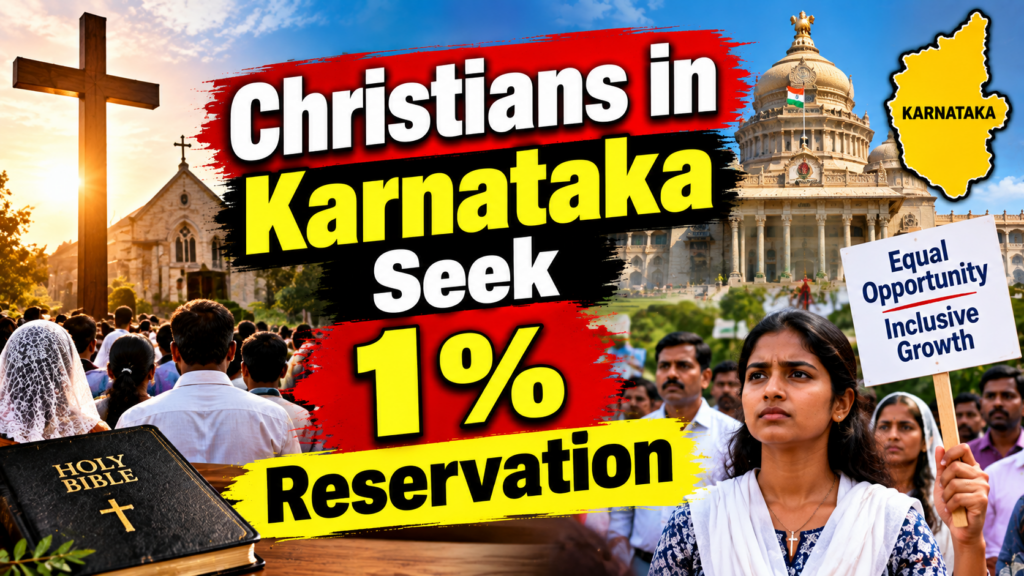
Christians in Karnataka Seek One Per Cent Reservation
Introductory note
Some Christian organizations in Karnataka are trying to repeal anti conversion law introduced by the BJP Government in the past. They are using All India Congress Committee (AICC) president Mallikarjun Kharge as a pawn to achieve their goal. Will Kharge budge?
Analytical view/ Analysis
A fresh debate over religious freedom, reservation and political representation has emerged in Karnataka after Christian community leaders sought the intervention of Congress president Mallikarjun Kharge on a series of long-standing demands. The delegation, led by Archbishop of Bengaluru Rev. Dr Peter Machado, met Kharge at his residence in Bengaluru on September 14 and urged him to press the Karnataka government to repeal the state’s anti-conversion law. The delegation also sought one per cent exclusive reservation for Christians, nomination of a Christian representative to the Legislative Council and greater representation in government boards, corporations and other statutory bodies.
The demands have come against the backdrop of the Karnataka Protection of Right to Freedom of Religion Act, 2022, commonly referred to as the anti-conversion law. The legislation was introduced by the then BJP government led by Basavaraj Bommai. An ordinance was promulgated in May 2022 and the legislation was subsequently enacted by the state legislature. The law prohibits religious conversion through misrepresentation, force, coercion, undue influence, allurement, fraudulent means or a promise of marriage. It also lays down procedures for people who intend to convert from one religion to another.
The burden of proof in cases of alleged unlawful conversion has become a contention for those practicing conversion. The law places the responsibility on the person who causes or facilitates the conversion to establish that it was not achieved through prohibited means. It also permits complaints regarding unlawful conversion to be made by the converted person or certain persons associated with the case. Violations can attract imprisonment and fines, with enhanced punishment in specified circumstances.
The political situation changed in May 2023 when the Congress came to power in Karnataka. Soon after taking office, the Congress government announced its intention to repeal the anti-conversion law. The promise generated expectations among Christian organizations, which have now renewed their demand for repeal.
The latest delegation has expanded the issue beyond repeal of the law. Christian leaders have sought a separate one per cent reservation for the community under the Backward Classes framework. They have also demanded political and administrative representation, including the nomination of a Christian member to the Karnataka Legislative Council and adequate representation on boards, corporations and other government-appointed bodies. According to the delegation, sections of the Christian community face socio-economic difficulties and require greater opportunities in education, employment and other areas of development.
The delegation’s meeting with Kharge has brought together two distinct issues: One is repealing of an existing law and providing reservation. Repealing a state law and creating a new reservation category involve different constitutional, legislative and administrative considerations. Reservation under the Scheduled Caste category is governed by the Constitution (Scheduled Castes) Order, 1950. Under Clause 3 of that Order, Scheduled Caste status is presently restricted to persons professing Hinduism, Sikhism or Buddhism. Christianity is not included in the list of religions covered by the provision.
A Supreme Court judgment delivered on March 24, 2026, in Chinthada Anand v. State of Andhra Pradesh. The case involved a person born into the Madiga Scheduled Caste community who had subsequently converted to Christianity. The Supreme Court held that a person professing Christianity could not retain Scheduled Caste status under the present Constitution (Scheduled Castes) Order, 1950. The Court further held that statutory benefits and protections that depend upon Scheduled Caste status cannot be claimed after such conversion.
The judgment is significant, though it could not be linked to the proposed demand. Any proposal for a separate Christian reservation would have to be examined under the relevant constitutional and statutory provisions in another perspective.
The Karnataka Christian delegation has argued that the community faces difficulties in obtaining adequate representation in government employment and institutions. Archbishop Machado has specifically called for a separate one-per-cent category, saying that Christians have not been able to obtain adequate benefits through existing arrangements.
Kharge’s role is significant because he is both the national president of the Congress and a senior political figure from Karnataka. The delegation sought his intervention with the state leadership. Karnataka Home Minister Priyank Kharge was also present during the meeting. Mallikarjun Kharge assured the delegation that he would take up the issues with the concerned state government leaders.
For the Christian community, the latest meeting represents a renewed attempt to place its concerns before the leaders, who matters.
News at a Glance:
Christian leaders seek Kharge’s intervention to repeal anti-conversion law
Abolish Anti-conversion law, Give us Special Reservation
Four percent reservation for Muslims in public contracts
Social Media Pulse: